Last updated: 8 October 2026. The screenshots were recorded on 4 and 5 October 2026 on an IQ Option Practice account registered in Brazil, and nothing was deposited or traded with real money. What IQ Option offers, and its payouts, assets and products, depends on the asset, the time and the country. The risk arithmetic is ours; the idea of risk per trade follows IQ Option’s blog on risking 1%, 2%, 5% or 10% of an account on each trade.
To get started in trading you need three things in this order: an understanding of what you are buying, a written plan with numbers, and a Practice account on which to test the plan before you risk your own money. On IQ Option the products are options, which have an expiry and a payout that is shown before you buy, and margin (CFD) trades on forex, stocks, crypto, commodities, indices and ETFs, which have no expiry and use leverage. In both, you trade the price: you do not own the asset, and each trade can lose what you put into it.
Quick answer
- Order: understand the product, write a plan with numbers, test it on the Practice account, then decide whether to use real money.
- On IQ Option: options (Blitz, Binary, Digital) with an expiry, and margin CFDs (forex, stocks, crypto, commodities, indices, ETFs) with leverage and no expiry. You do not own the asset.
- Break-even: an option has to be won more than 1 ÷ (1 + payout) of the time: more than 52.6% at a 90% payout.
- Risk per trade: after five losses in a row, 4.9% of the account is gone at 1% risk per trade and 41% at 10%.
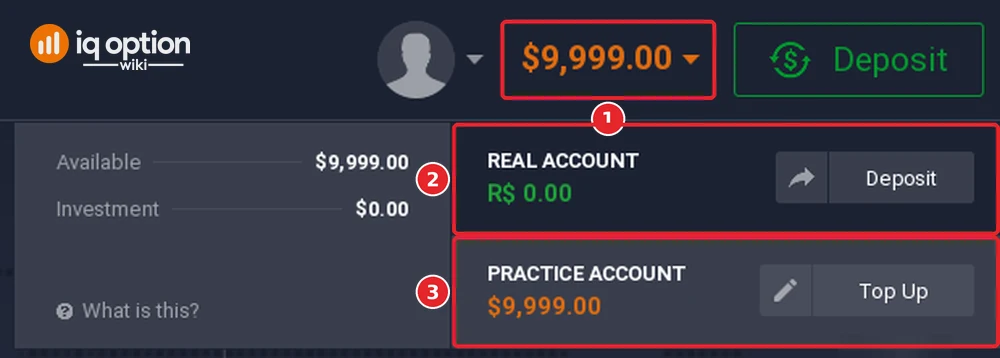
- Practice account: shown in the balance menu with a Top Up button ($9,999.00 on 5 October 2026).
Understanding the Basics of Trading
Trading is buying and selling financial instruments to profit from price changes. The classic forms are shares, currencies, options and futures. What you can do on IQ Option is narrower, and it is not the same as owning the asset:
| Type of trading | What it is on IQ Option |
|---|---|
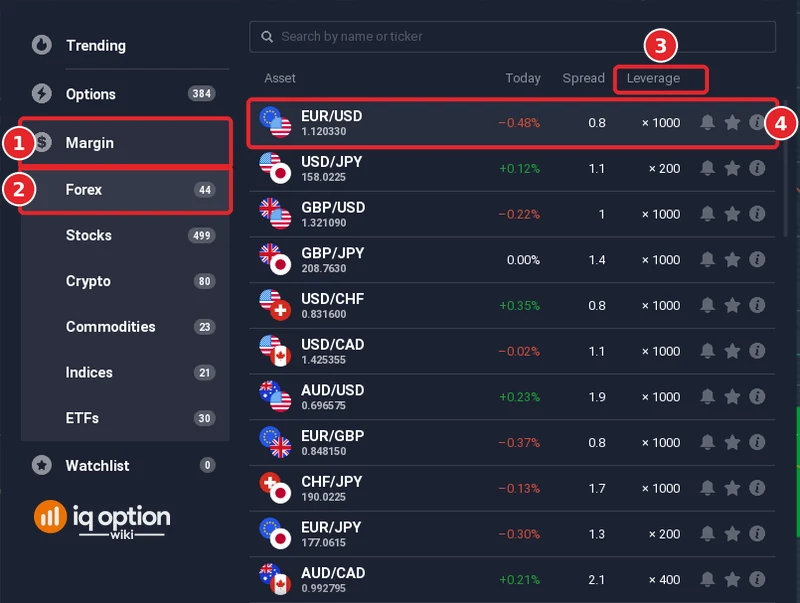
| Stocks | A CFD on a company share, not the share. The Margin menu listed 499 stocks on 5 October 2026. |
| Forex | A margin trade on a currency pair with no expiry. The Margin menu listed 44 forex pairs. |
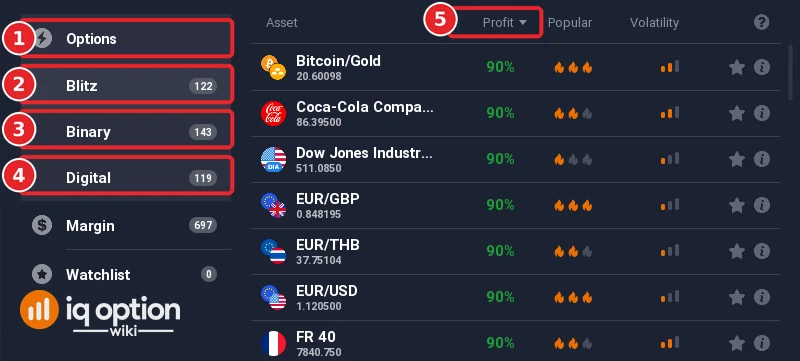
| Options | Blitz, Binary and Digital options: you choose a direction and an expiry, and the payout is shown or set by the strike. These are contracts that settle at expiry, with no right to buy or sell the asset. The Options menu listed 384 assets on 5 October 2026. |
| Futures | The Margin menu has no Futures group: it lists Forex, Stocks, Crypto, Commodities, Indices and ETFs. |
The Options menu and the Margin menu are the two places to start. The Options menu lists the three option types, with the payout of every asset in the Profit column; the Margin menu lists the groups of margin assets, with a Leverage column.
Key Trading Concepts
- Leverage: the multiplier of a margin trade. $1 at ×1000 gives a position of $1,000, so a price move is worth more, in profit and in loss. See what is leverage.
- Margin: the money you put into a margin position, which IQ Option sets aside as security for it. The platform can close a position when the margin rules require it.
- Payout and break-even: an option pays a percentage when you win and loses the amount when you lose, so you have to win more than 1 ÷ (1 + payout) of your trades: more than 52.6% at a 90% payout.
- Spread: the difference between the Buy and the Sell price of a margin asset; it is a cost of every position.
- Risk management: deciding in advance how much you can lose on one trade and in one day.
Setting Goals and Building a Trading Plan
A goal such as “make money trading” cannot be checked. A plan can: it names the asset, the candle size, the entry rule in numbers, the expiry or the stop loss, the amount per trade and the point at which you stop for the day. Our tested strategy guides show what a written rule looks like and how few signals a week of data gives; see trading plan examples and the strategy guides. Keep a trading journal with the entry, the exit, the amount and the reason for each trade.
Risk per trade
IQ Option’s blog compares traders who risk 1%, 2%, 5% or 10% of the account on each trade. If each trade risks a fixed percentage of the current balance, the share of the account lost after a losing streak is 1 − (1 − risk)losses:
| | Risk 1% | Risk 2% | Risk 5% | Risk 10% | |
|---|---|---|---|---|
| 3 losses in a row | −3.0% | −5.9% | −14.3% | −27.1% |
| 5 losses in a row | −4.9% | −9.6% | −22.6% | −41.0% |
| 10 losses in a row | −9.6% | −18.3% | −40.1% | −65.1% |
On a $10,000 balance, 1% is $100 per trade. A losing streak is a normal part of any strategy, so the percentage you choose decides how long you can keep trading through one. The money management guide goes further.
Choosing the Right Brokerage
Check the same things for any broker. Who is the company, and in which territories is it licensed? IQ Option’s terms name SKY LADDER LLC, registered in Antigua and Barbuda, as the company behind the global brand, and IQ Option says it provides its services only in the territories in which it is licensed, so check whether your country is served. What does it cost? The Trading Specifications page lists the spreads, the leverage limits and the swaps for margin assets, and says that overnight funding may be charged for open positions. How do you reach support? The traderoom has a SUPPORT button and the address support@iqoption.com with the words “every day, around the clock”; the Contact page lists the email address. Is there a Practice account? Read is IQ Option legit and the review for how we checked these points.
Funding Your Trading Account
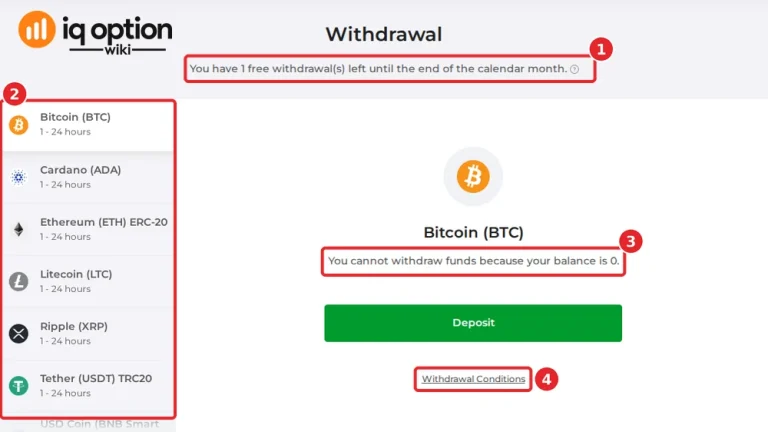
The Real account has a Deposit button, and the methods, the minimum and the currency depend on your country: card, e-wallet, bank transfer and crypto appear in different lists. Start with the guide for your country in the deposit guides. Only put in money you can afford to lose, and check the withdrawal conditions before you deposit; see how to withdraw money.
Developing a Trading Strategy
A strategy is a set of rules written down before you trade. The three common approaches are technical analysis, which reads price charts and indicators (see the indicator guides); fundamental analysis, which reads economic and financial news (see the economic calendar guide); and price action, which reads candles and levels (see price action trading). Test a rule on the Practice balance before you trade it with real money. IQ Option’s blog says that most strategies need dozens, and often hundreds, of trades before a result means anything, and that the rules must stay fixed from start to finish.
Practicing with a Demo Account
IQ Option calls it the Practice account. Click the balance in the top bar (1) to open the balance menu: it lists the Real account (2) and the Practice account (3), which showed $9,999.00 and a Top Up button on 5 October 2026. Trade on it as you plan to trade with real money: the same amounts, the same expiries, the same rules. Count your results over a few dozen trades, and compare your win rate with the break-even rate of the payout you got. How to open an account is in how to register, and the first trade is in how to start trading on IQ Option.
Trading with Real Money
- Manage risk. Decide the amount per trade as a share of the balance, use a stop loss on margin trades, and stop for the day after a number of losses that you set in advance.
- Place trades by the plan. Enter when your rule says so, not when the chart feels exciting, and close by your exit rule.
- Track performance. Record every trade, and review the win rate, the average win and the average loss each week.
Common Mistakes to Avoid
- Overtrading. More trades are more spreads and more chances to break your own rules.
- Trading without a plan. A rule that is not written down changes after every loss.
- Using the maximum leverage. At ×1000 a move of 0.1% against you uses up the whole investment.
- Judging a strategy by a few trades. A week of results says little; IQ Option’s blog asks for dozens to hundreds.
- Letting emotions decide. Fear and greed push traders to double the amount after a loss; see trading psychology.
Pros and Cons of Trading
| Pros | Cons |
|---|---|
| A Practice account lets you learn the platform and test a rule without risking money. | Each trade can lose its whole amount, and most strategies need many trades to judge. |
| Options show their payout before you buy; margin trades have a stop loss and a take profit. | Leverage multiplies losses, spreads and funding are costs, and the platform can close a margin position. |
| You can trade a rising or a falling price. | You do not own the asset, and what is offered depends on your country. |
Related guides
- How to start trading on IQ Option and what is options trading
- What is a CFD and what is leverage
- Money management and trading psychology
- All indicator guides and all strategy guides
Frequently Asked Questions
Q: What do I need to start trading on IQ Option?
A: An account, and for your first trades the Practice account, which holds virtual dollars. The Real account needs a deposit by a method available in your country.
Q: How much should I risk on one trade?
A: That is your decision, and it should be a fixed share of the balance that you can lose several times in a row. IQ Option’s blog compares 1%, 2%, 5% and 10%: after five losses in a row, 4.9% of the account is gone at 1% and 41% at 10%.
Q: Do I own the asset when I trade on IQ Option?
A: No. An option is a contract on a price at a time, and a margin trade is a CFD, a contract on the price difference.
Q: How long should I practise?
A: Until you have counted the results of your written rule over a few dozen trades, at the amounts you plan to use. A short test proves nothing about the future.
Q: Can I lose more than I put in?
A: A binary option loses its amount. For margin trades and digital options, read IQ Option’s terms and notes: a margin position can draw on your balance if you allow it, and IQ Option’s blog says a digital loss can exceed the investment.