Last updated: 8 October 2026. Every screenshot below was recorded on 5 October 2026 on an IQ Option Practice account registered in Brazil, on EUR/USD. We placed no real-money trade. What a trader can choose, and which payouts and expiries are offered, depends on the asset, the time and the country, so read the figures here as what that account showed on that day.
A binary option and a digital option both ask you to say whether the price will be higher or lower when the option expires. A binary option pays a fixed percentage if you are right and loses the amount if you are wrong. A digital option adds a strike price: you choose the level the price has to pass, and the payout depends on that level, so a strike far from the current price pays more and is less likely to be reached. The two also differ in the expiries on offer. This guide shows both on IQ Option’s current platform, step by step, and compares them in a table. It does not say which is better, because that depends on your rule.
Quick answer
- Binary option: you choose Higher or Lower; the payout is a fixed percentage shown before you buy (91% and 93% on the EUR/USD expiration list, 5 October 2026).
- Digital option: you also choose a strike price; the payout depends on the strike (277% on one strike above the price on 5 October 2026).
- Expiries: binary from 1 minute to the end of the month; digital 1, 5 and 15 minutes (IQ Option’s blog and the lists we saw).
- Loss: a binary option loses at most the amount invested; IQ Option’s blog says a digital loss can exceed it.
- No stop loss: neither type has a stop loss or take profit.
- Break-even: a trade has to win more than 1 / (1 + payout) of the time: 54% at 85%, 53.5% at 87%.
Binary vs digital options wiki Q&A
IQ Option’s blog describes binary and digital options as derivatives: their value is tied to an underlying asset, and when you buy one you do not own that asset. You decide whether its price will rise or fall over a set time. When the option expires, the trade closes automatically and you either earn a profit or lose the amount you invested. In the asset menu the types sit under Options, next to Blitz, which is a third, faster type; on 5 October 2026 the menu showed Blitz 115, Binary 136 and Digital 110.
What is an option
An option here is a contract on a price at a time. You do not buy or sell the asset; you choose a direction and an amount, and the contract settles at expiry. IQ Option’s own terms define a digital option contract as a derivative where the client earns a payout if they correctly predict the price movement of the underlying asset at the time of the option’s expiry, and they say that if it expires at the selected strike price, the investment is returned.
Binary option trading on IQ Option
A binary option, also called a high-low option, is a bet on direction only. You choose Higher or Lower, an amount and an expiry. Your entry price is the reference: Higher wins if the price at expiry is above it. The payout is a fixed percentage of the amount, shown before you buy, and it depends on the asset and the expiry. IQ Option’s blog says binary options can pay up to 95%; on 5 October 2026 the EUR/USD Binary expiration list showed 91% in one column and 93% in the other. You cannot lose more than your amount or win more than the preset percentage, and the trade has no stop loss or take profit.
Digital options trading on IQ Option
A digital option adds the strike price, the level the closing price has to exceed for a Higher option or fall below for a Lower one. You pick the strike from a set of levels on the chart, and the percentage you earn depends on how likely the price is to reach it: the lower the likelihood, the higher the payout. IQ Option’s blog says digital payouts can reach 900%, and on the recording one strike above the price showed 277%. The blog’s table also says that digital losses can exceed the initial investment; we placed no trade, so we could not check what the trade panel shows as the loss, and you should read it before you buy. IQ Option’s order execution policy says no commissions or financing fees are charged for digital option contracts, and it reserves the right to apply charges in future with notice.
Similarities between binary option and digital option asset types on IQ Option
- A fixed expiry. When the time is reached the position closes automatically. The expiry is marked on the chart by a vertical red line.
- The same question. You say whether the price will be higher or lower than a reference level at expiry: the entry price for a binary option, the strike for a digital one.
- A purchase deadline. A dotted white line on the chart marks the last moment you can buy; the platform shows a purchase-time countdown.
- The same amount box. The Invest box on the right-hand panel took $1 on the Practice account, and IQ Option’s Help says the maximum is $20,000 per trade, lower for some assets.
- A sell option. IQ Option’s blog says an option can be closed before expiry with the Sell button in the upper right of the chart or from Show Positions. IQ Option’s help article on expirations says assets with an expiration have this buyback feature, with a Sell button and the profit after the sale. We did not test it.
On 5 October 2026 the asset menu showed Binary 136 and Digital 110. The counts change: the menu of 4 October 2026 showed Blitz 169, Binary 178 and Digital 173. Check the menu on your own account.
What is the difference between binary and digital trading in IQ Option?
| Feature | Binary option | Digital option |
|---|---|---|
| What decides the result | The direction of the price at expiry | The direction relative to the strike you chose |
| Payout | Fixed percentage shown before you buy: 91% and 93% on the EUR/USD expiration list on 5 October 2026 | Changes with the strike: 90% on the panel, 277% on one strike above the price (5 October 2026) |
| Expiries | The expiration list shows one-minute steps, 15-minute marks, then the end of the day, the week and the month | 1, 5 and 15 minutes (the list showed the labels 1M, 1M, 5M and 15M) |
| Strike price | None: the entry price is the reference | Chosen from the levels on the chart |
| Loss | The amount you invested | IQ Option’s blog: can exceed the amount invested |
| Stop loss and take profit | None | None |
| Assets in the menu | 136 on 5 October 2026 | 110 on 5 October 2026 |
The break-even rate shows why the payout and the chance cannot be separated. A trade has to win more than 1 / (1 + payout) of the time. At a binary payout of 85% that is more than 54%; at 87%, about 53.5%. At a digital payout of 277% it is more than 26.5%, but IQ Option’s blog says the lower the probability of the price reaching a strike, the higher its payout. The payout alone says nothing about the odds.
The digital list we saw stopped at 15 minutes, while the binary list ran to the end of the month, so a strategy that holds an option for an hour fits the binary list but not the digital one.
Trading a binary option on IQ Option
These steps use the web traderoom on a Practice balance, which starts at $10,000 and has a Refill to $10,000 button. The numbers in each screenshot match the numbers in the text.
Step 1: Choose a binary asset
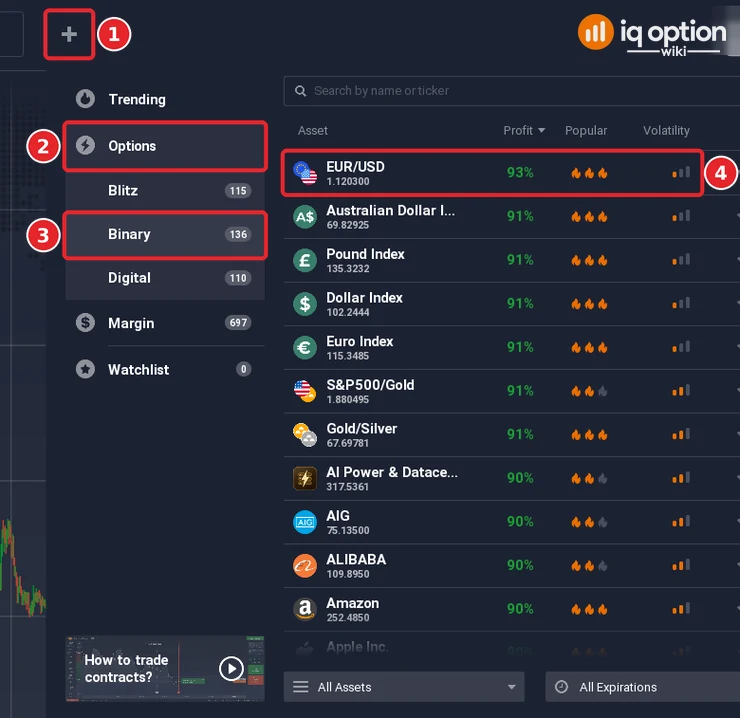
Click + in the top bar (1), open Options (2) and choose Binary (3). The list shows each asset’s payout. Pick the asset (4); the screenshots use EUR/USD.
Step 2: Choose the expiry
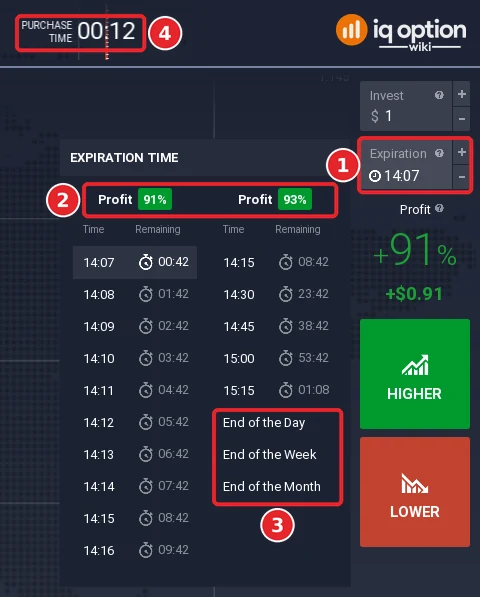
In the right-hand panel open the Expiration box (1). The Expiration time list shows clock times with the time remaining, and each column has its own payout (2). The list runs in one-minute steps for the next minutes, then in 15-minute marks, and ends with End of the Day, End of the Week and End of the Month (3). The purchase-time countdown (4) shows how long you have to buy. Pick the entry you want.
Step 3: Enter the amount and choose a direction
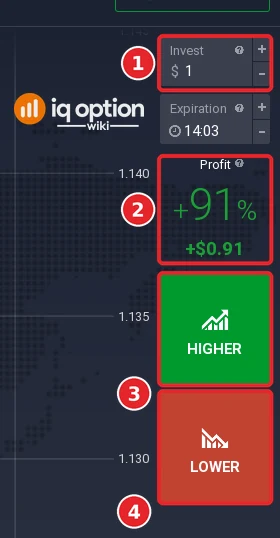
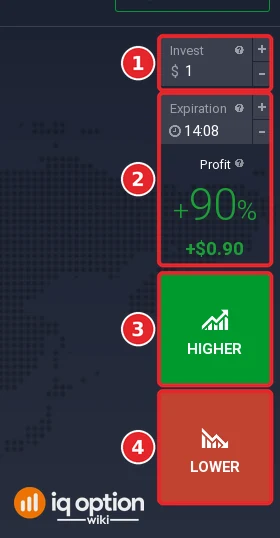
Type the amount in the Invest box (1). The panel shows the payout and the profit it would bring (2): +91% and +$0.91 for $1 and the 14:03 expiry on the recording, although the list showed 93% for EUR/USD. Click Higher (3) if you expect the price to be above the entry price at expiry, or Lower (4) if you expect it to be below. The trade closes at the red line.
Pros and Cons of Binary vs Digital Options
| Type | Pros | Cons |
|---|---|---|
| Binary | The payout is fixed and shown before you buy, so break-even is one calculation. | The payout is capped, and the direction is all you control. |
| Digital | You choose the strike, and a strike far from the price pays more. | The payout changes with the strike, the expiries stop at 15 minutes, and IQ Option’s blog says a loss can exceed the amount invested. |
| Both | A fixed expiry and a Practice balance to rehearse on. | Both need market analysis, and each trade can lose its amount. |
How Do Digital Options Work on IQ Option
Step 1: Choose a digital asset
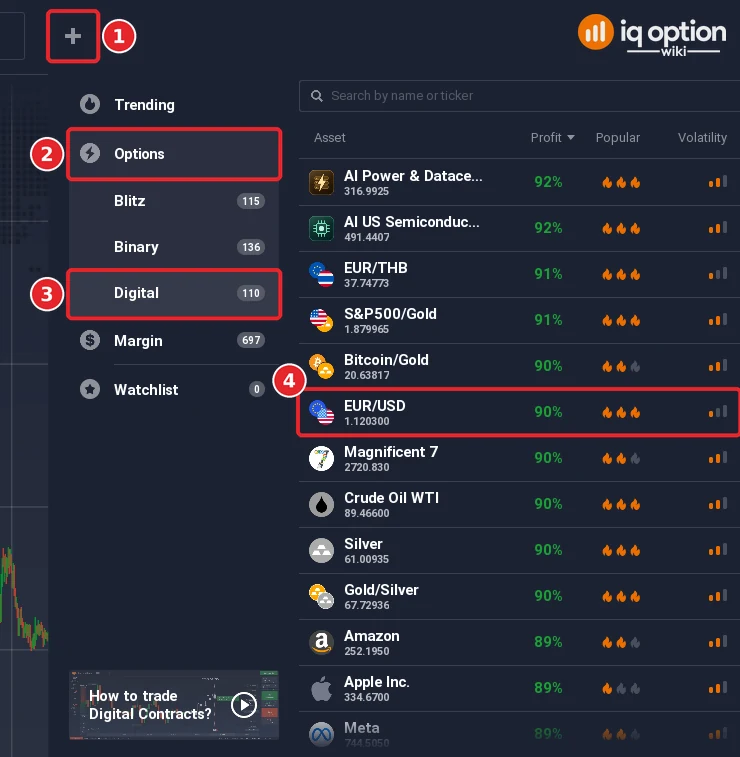
Click + in the top bar (1), open Options (2) and choose Digital (3), then pick the asset (4). The payouts listed differ from the Binary list: on 5 October 2026 EUR/USD showed 93% under Binary and 90% under Digital.
Step 2: Choose the expiry
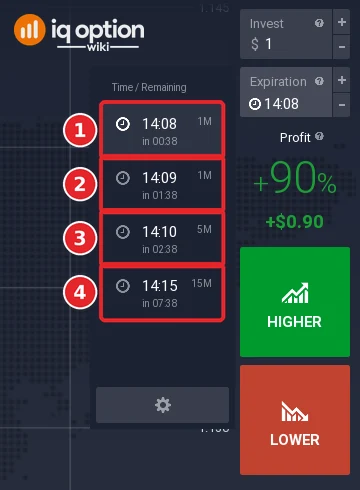
The digital expiry list is short. It lists times with the time remaining and a label: 1M (1), 1M (2), 5M (3) and 15M (4) on the recording. Click the entry you want. The chosen time appears in the Expiration box on the right.
Step 3: Show the strike levels
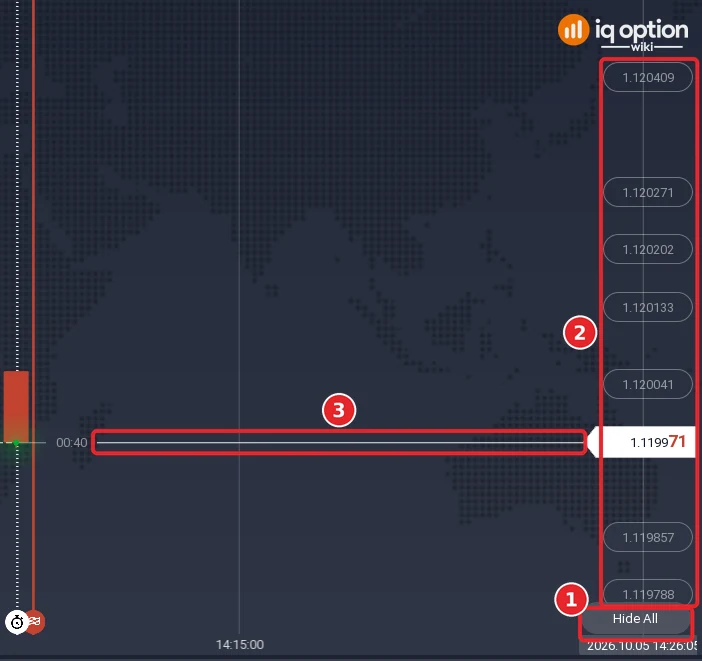
Click Show All at the bottom right of the chart; the button then reads Hide All (1). On the 1-minute chart, boxes with prices appear at the right edge (2); IQ Option’s blog calls them strike price levels. The current price is the line across the chart (3). On the 5-minute chart in our recording the button also read Hide All, but no strike boxes were drawn, so switch to a shorter candle if they do not appear. Click Hide All to remove the boxes.
Step 4: Hover over a strike
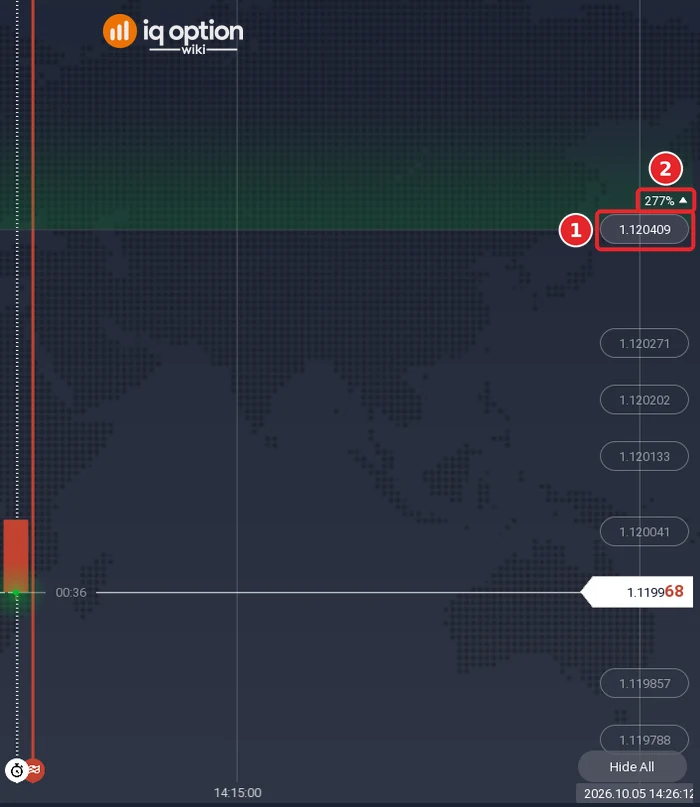
Move the pointer over a strike box (1). IQ Option’s blog says the expected profit percentage changes as you hover. In our recording the strike 1.120409, above the price of 1.119968, showed 277% with an upward arrow (2), and the chart shaded the area above that strike in green; the panel on the right still read +90%. According to the blog you choose the strike from the Expiration section, manually or with auto-selection of the nearest strike; we did not click a strike, so we cannot show what the panel displays afterwards. If the price closes exactly on the strike, IQ Option’s terms say the investment is returned.
Step 5: Enter the amount and choose a direction
Enter the amount in the Invest box (1), check the expiry and the profit on the panel (2), then click Higher (3) or Lower (4). Before the purchase deadline you can open more than one option on the same asset, in either direction and at any strike, according to IQ Option’s blog. Your open options are under Show Positions at the bottom right.
Binary vs digital options, which to choose?
Choose by the rule you want to trade, not by the payout. A rule that holds an option for an hour, or until the end of the day, can only be traded as a binary option on the lists we saw. A rule that needs a one-, five- or 15-minute option can use either, and a digital strike lets you ask for a bigger payout at a lower chance, or a smaller one at a higher chance. Whichever you use, count your results on the Practice balance over a few hundred trades and compare your win rate with the break-even rate for the payout you actually got. IQ Option’s blog says that strategies for binary options also work for digital options; we have not tested that.
Troubleshooting and common mistakes
- You expected a fixed payout on a digital option. It changes with the strike. Check the percentage on the panel before you click.
- The expiry you wanted is missing. Digital options list 1, 5 and 15 minutes. For a longer expiry, look at the Binary list.
- The strike boxes are not on the chart. Click Show All at the bottom right, and use a 1-minute chart: on the 5-minute chart in our recording no boxes were drawn.
- The trade closed earlier than planned. The red line marks the expiry. A late click on a clock-time entry shortens the trade.
- You expect a stop loss. Neither type has one: an option closes at its expiry time or when you sell it.
Related guides
- How to start with digital options
- Expiry times on IQ Option and selling options before expiration
- Choosing a trading asset
- Guide to trading candles on IQ Option
- All indicator guides and all strategy guides
Frequently Asked Questions
Q: Which is better for beginners, binary or digital options?
A: Neither is shown to be better. A binary option has a fixed payout, so the break-even rate is a single number, and that is easier to work out. A digital option adds the strike price and a payout that changes with it. Start on the Practice balance with either.
Q: Can I use the same strategy for binary and digital options?
A: IQ Option’s blog says strategies for binary options also work for digital options. The expiries differ, so a rule has to fit the expiry list of the type you use, and the payout of a digital option depends on the strike.
Q: Can you win with binary options?
A: A trade wins when its direction is right at expiry, and it pays the fixed percentage shown. A trader has to win more than 1 / (1 + payout) of the trades to break even, and every trade can lose its whole amount.
Q: What expiries do binary and digital options have?
A: IQ Option’s blog gives 1 minute to 1 month for binary options and 1, 5 and 15 minutes for digital options. Both lists were as described on 5 October 2026.
Q: Do binary and digital options have a stop loss?
A: No. An option closes at its expiry time, or earlier if you sell it. Only a CFD (margin) trade has a stop loss and a take profit.
Q: Are both available in every country?
A: We cannot say. The screenshots are from an account registered in Brazil. What is offered depends on your country, so check the asset menu on your own account.