Last updated: 8 October 2026. The formulas are quoted from IQ Option’s Help page on trading, saved on 5 October 2026, and every number in the worked examples is computed from them. The screenshots were recorded on 5 October 2026 on an IQ Option Practice account registered in Brazil: one EUR/USD Forex position of $1 at ×1000 opened and closed by hand, without real money. We did not recalculate that position, because the screenshots do not show its closing price.
A CFD position on IQ Option earns or loses the percentage change of the price, applied to the whole volume of the trade. IQ Option’s Help page gives two formulas, where the multiplier is the Leverage box of the order panel. For a long position (Buy): profit = (closing price ÷ opening price − 1) × multiplier × investment. For a short position (Sell): profit = (1 − closing price ÷ opening price) × multiplier × investment. A negative result is a loss. The formulas leave out the spread and any overnight funding, which the platform charges on top.
Quick answer
- Long (Buy): profit = (closing price ÷ opening price − 1) × multiplier × investment.
- Short (Sell): profit = (1 − closing price ÷ opening price) × multiplier × investment. A negative number is a loss.
- Examples: long, $1,000 at ×5, 12 to 15: $1,250.00. Short, $5,000 at ×3, 13 to 11: $2,307.69. IQ Option’s AUD/JPY example gives $1,819.83.
- The multiplier is the Leverage box of the order panel; the Volume is the investment multiplied by it.
- Not in the formula: the spread and overnight funding, which the platform charges on top.
How to calculate profit for a long position
A long position is a Buy: you gain when the price rises above the opening price. IQ Option’s Help page has the brackets around the whole ratio, as above.
Example. You invest $1,000 at ×5 and buy at an opening price of 12. You close at 15. The profit is (15 ÷ 12 − 1) × 5 × $1,000 = 0.25 × 5 × $1,000 = $1,250.00. The volume of the trade was $5,000, and the price rose by 25%.
A losing long position. Invest $100 at ×10, buy at 12 and close at 11: (11 ÷ 12 − 1) × 10 × $100 = −$83.33. With $1,000 invested at ×5, the position loses the whole $1,000 when the price falls by 20%, to 9.60: (9.6 ÷ 12 − 1) × 5 × $1,000 = −$1,000.00.
Calculate profit for a short position
A short position is a Sell: you gain when the price falls below the opening price. The formula is (1 − closing price ÷ opening price) × multiplier × investment.
Example. You invest $5,000 at ×3 and sell at an opening price of 13. You close at 11. The profit is (1 − 11 ÷ 13) × 3 × $5,000 = 0.1538… × 15,000 = $2,307.69.
IQ Option’s own example. The Help page gives AUD/JPY, a short position, opening price 85.173, closing price 85.142, multiplier 2000 and an investment of $2,500: (1 − 85.142 ÷ 85.173) × 2000 × $2,500. Computed to the cent that is $1,819.83; the Help page prints it as $1.819.82, a rounding difference of one cent.
| | Long position (Buy) | Short position (Sell) | |
|---|---|---|
| You expect | The price to rise | The price to fall |
| Profit | (closing ÷ opening − 1) × multiplier × investment | (1 − closing ÷ opening) × multiplier × investment |
| Example | $1,000, ×5, 12 → 15: $1,250.00 | $5,000, ×3, 13 → 11: $2,307.69 |
| A result below zero | The closing price is below the opening price | The closing price is above the opening price |
What the formula leaves out, and where the platform shows the result
The formula uses the opening and the closing price only. A real position also pays the spread, the difference between the Buy and the Sell price, and IQ Option’s Trading Specifications page says that overnight funding may be charged for holding open positions. Both reduce what you receive, which is why a position can start below break-even. Follow these steps on a Practice balance to see the platform’s own figures.
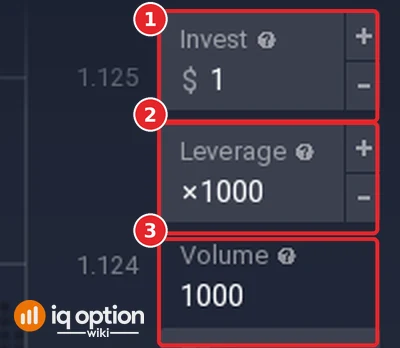
Step 1: Read the Invest, Leverage and Volume boxes
The order panel shows the Invest box (1), the Leverage box (2) and the Volume (3), which is the investment multiplied by the leverage. On the recording the panel showed $1, ×1000 and a Volume of 1000.
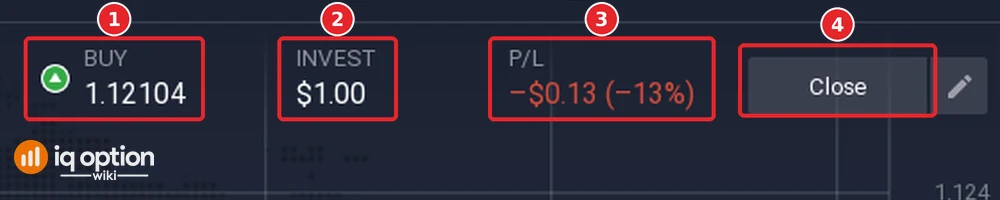
Step 2: Watch the position bar
After you click Buy or Sell, a bar opens above the chart with the direction and the price of the position (1), the invested amount (2), the profit or loss in dollars and percent (3) and the Close button (4). On the recording the Buy position was opened at 1.12104 with $1.00, and the bar showed −$0.13 (−13%) at one moment. That percentage is the loss as a share of the $1 invested, not of the price.
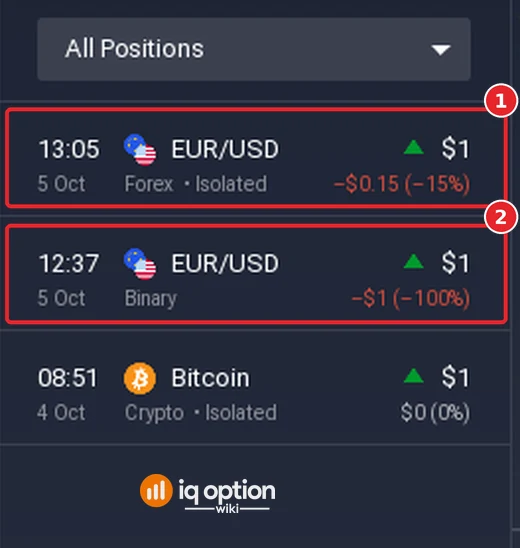
Step 3: Read the result in Trading History
Open Trading History in the left sidebar. The closed Forex position (1) was listed as EUR/USD, Forex, Isolated, $1 and −$0.15 (−15%). The row below it (2) is a binary option from the same day that lost its $1 (−100%), which shows the difference: a binary option pays a fixed percentage or loses the amount, and a margin position’s result follows the formula above.
Pros and Cons of calculating before you trade
| Pros | Cons |
|---|---|
| You can see how much a given move is worth before you open the position, and what move wipes out the investment. | The formulas ignore the spread and overnight funding, so the platform result is lower than the calculation. |
| IQ Option’s Help page gives the same two formulas for CFD trading in general. | A calculation does not predict the price. It only converts a price move into dollars. |
Common mistakes
- Dividing the closing price by the opening price minus one. The ratio is closing ÷ opening, and then you subtract 1.
- Using the leverage as a percentage of the investment. The multiplier multiplies the whole position: $100 at ×10 is a $1,000 position.
- Forgetting costs. The spread is paid on every position, and holding it overnight can cost funding.
- Mixing up the sign for a short position. A short position gains when the closing price is lower, and the formula already handles it.
Related guides
- What is leverage on IQ Option and what is a CFD
- Trade forex on IQ Option and stock CFDs on IQ Option
- IQ Option fees and commissions
- All indicator guides and all strategy guides
Frequently Asked Questions
Q: What is the formula for profit on a long CFD position at IQ Option?
A: (Closing price ÷ opening price − 1) × multiplier × investment. IQ Option’s Help page writes it “(Closing price / Opening price – 1) x multiplier x investment”.
Q: What is the formula for a short position?
A: (1 − closing price ÷ opening price) × multiplier × investment.
Q: Is the multiplier the same as the leverage?
A: Yes. The order panel calls the box Leverage, and its help note calls it “the multiplier”. The Volume of the trade is the investment multiplied by it.
Q: Do the formulas include the spread and overnight funding?
A: No. The formulas use the opening and closing prices only. The Trading Specifications page says the spread varies with market conditions and that overnight funding may be charged for holding open positions.
Q: Where do I see my profit on the platform?
A: On the position bar above the chart while the position is open, in the Positions panel at the bottom, and in Trading History after it closes.
Q: Can I practise the calculation without risking money?
A: Yes. The Practice balance starts at $10,000 and has a Refill to $10,000 button. Open a small position, note the opening price, and compare the bar’s profit with the formula, keeping the spread in mind.