Last updated: 8 October 2026. The chart pictures were recorded on 8 October 2026 on an IQ Option Practice account registered in Brazil, on 5-minute EUR/USD candles of 30 September 2026 scrolled back on the same chart, and we placed no real-money trade. The times in this guide are the traderoom clock, which is UTC minus three hours, and a candle is named by the time it opens. The numbers in the tested box come from a replay of hypothetical margin trades on a week of recorded candles, without spread, swap or slippage; they say nothing about what the exits will do next. Nothing here is a promise of profit.
An exit strategy says in advance where a margin (CFD) trade will end: at a take profit, at a stop loss, or when you close it. IQ Option’s Help describes a stop loss as “an order that the trader sets to limit losses for a particular open position” and a take profit as a way “to lock in a profit when a certain price level is reached”, and its blog says “Set stop losses and targets before you enter.” This guide compares three ways to place the stop: beyond a support or resistance level, along a moving average, and from the average true range (ATR). We counted all three on the same 159 breakout entries from a week of EUR/USD candles: only the moving-average exit ended the week in profit, and all of that profit came from short trades in a week when the euro fell.
Quick answer
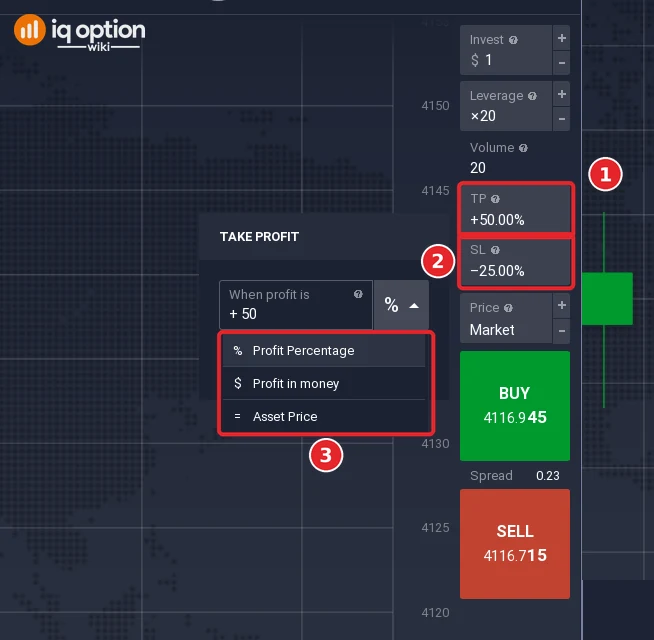
- Where it is set: margin trades only (Forex, Crypto, Stocks, Commodities and the other Margin groups): the TP and SL fields of the order panel, as a percentage, an amount of money or an asset price. A binary option has no stop loss.
- Exit 1: the stop 0.5 pip beyond the broken level, the target at the same distance.
- Exit 2: the trade ends when a candle closes on the other side of the SMA(30).
- Exit 3: the stop at one or two times the ATR(14) from the entry, the target at the same distance.
- Test result: on 159 breakout entries of a week of 5-minute EUR/USD candles, exit 1 ended at -31.4 pips (45.3% of trades positive), exit 2 at +313.9 pips (31.4%), exit 3 at one ATR at -4.5 pips (52.2%) and at two ATRs at -95.2 pips (48.4%). Exit 2 made all its profit on the short trades, in a week when the euro fell. No spread or swap is counted.
- Break-even: a 1:1 setup needs a win rate of 50% before costs (IQ Option’s blog: “A 1:1 setup needs only a 50% win rate to break even”). Exit 3 at one ATR had 52.2% of 159 trades positive, within the margin of error of about ±4 points of that, and the spread and the swap are not counted here.
What are exit strategies on IQ Option?
A binary or digital option has no stop loss or take profit: it closes at its expiry. A margin trade (Forex, Crypto, Stocks, Commodities and the other Margin groups) stays open until a take profit, a stop loss or a close ends it. On the order panel the two fields are labelled TP and SL, and each opens a small window where you enter the value in one of three units: a percentage, an amount of money or an asset price. In our traderoom the panel showed a take profit of +50.00% and a stop loss of −25.00% (values that may have been saved from an earlier session, so we do not call them defaults), and the window says “These preferences will be applied to the new position you open”. Our guide to auto closing covers the fields; the gold guide shows the windows.
IQ Option’s Help adds a warning: slippage can occur when trading CFDs, “the difference between the expected order price and the price at which the order is actually executed”, and it most likely occurs “during periods of increased volatility”. A stop loss is therefore a limit on the plan, not a guaranteed price.
Exit 1: a stop loss beyond support or resistance
The oldest rule: put the stop where the trade is shown to be wrong. IQ Option’s blog says “Invalidation sits beyond the zone — not on its edge” and “Swing traders place stop losses below support in an uptrend or above resistance in a downtrend.” A long trade opened on a break above a resistance level has its stop just under that level, which is the support now; a short has it just above the broken support. The tested rule puts the take profit at the same distance from the entry as the stop (a 1:1 target).
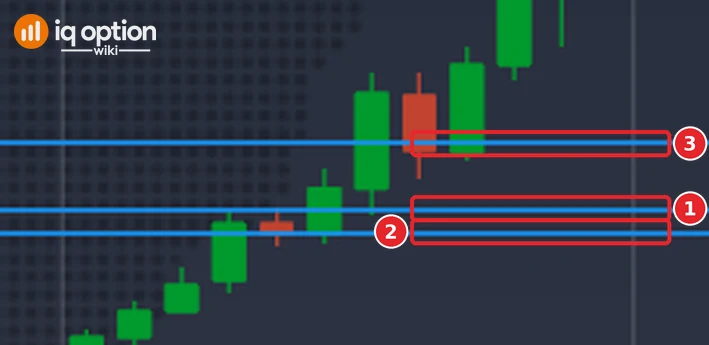
In our example the 02:25 candle on 30 September 2026 closed at 1.133555, above the highest high of the 20 candles before it, 1.133510 (the level, 1). The stop sits 0.5 pip beyond the level, at 1.133460 (2), 0.95 pip under the entry, and the 1:1 target at 1.133650 (3). The next candle reached the target.
Exit 2: a dynamic stop that follows a moving average
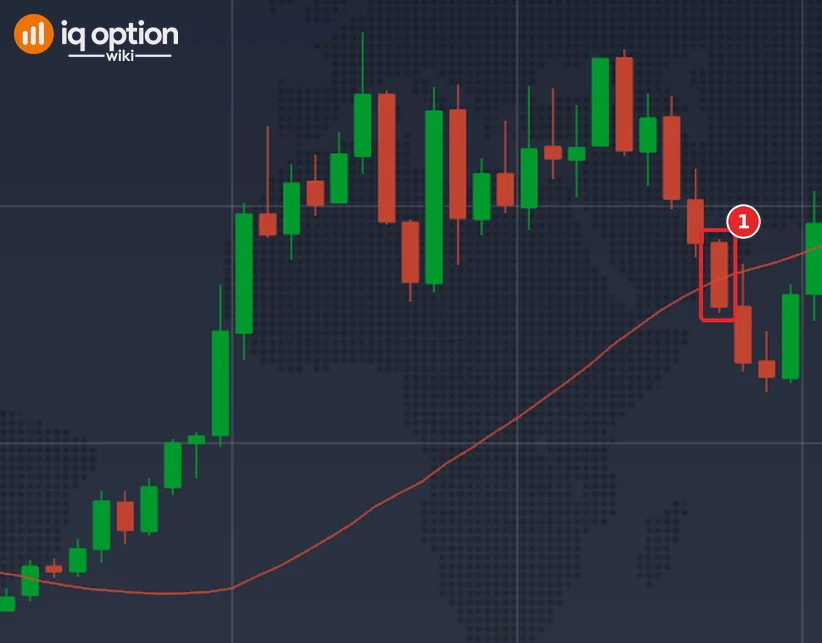
A dynamic exit has no fixed price: it follows an indicator. This exit uses the SMA(30): in an uptrend the candles stay above it, and the trade ends when a candle closes under it. IQ Option’s blog gives the same idea for trailing: “Exit when price closes through a 20 or 50 EMA in the opposite direction.” To add the average, open Chart analysis, choose Moving Average, set the period to 30 and keep the type SMA.
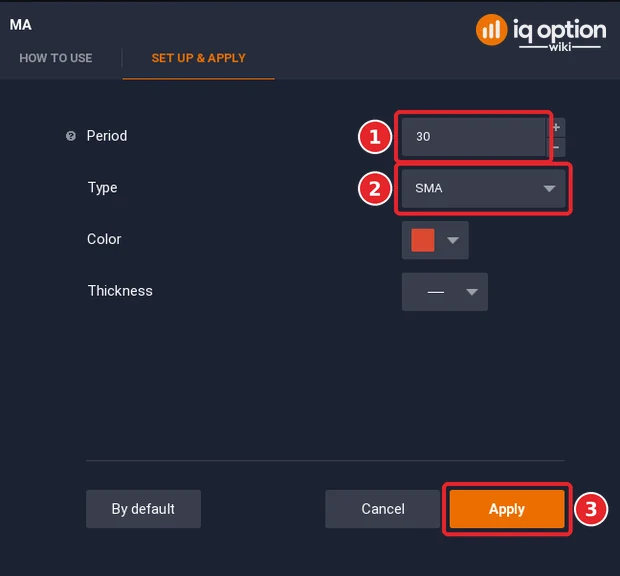
In the same trade the SMA(30) stood at 1.133386 at the entry and rose with the price. The 04:40 candle was the first to close under it: it closed at 1.134575 with the SMA at 1.134710 (1), and the position ended there, 10.2 pips above the entry, 27 candles after it opened.
Exit 3: a stop loss from the ATR
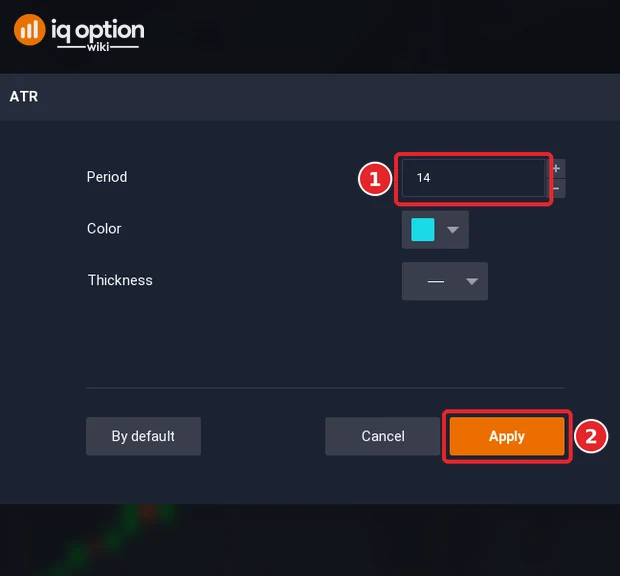
The ATR measures how far price usually moves in a candle, so a stop built from it widens when the market is busy and narrows when it is quiet. IQ Option’s blog gives the formula, “Stop distance = ATR x multiplier”, and says “Fourteen periods is a common default, not a rule.” and “Use 2–3× ATR on the trade’s timeframe.” To add the ATR, open Chart analysis, type Average True Range in the search box (a search for ATR lists ATR Trailing Stops first, which is a different indicator) and apply it with the default period of 14; it appears in its own panel under the price.
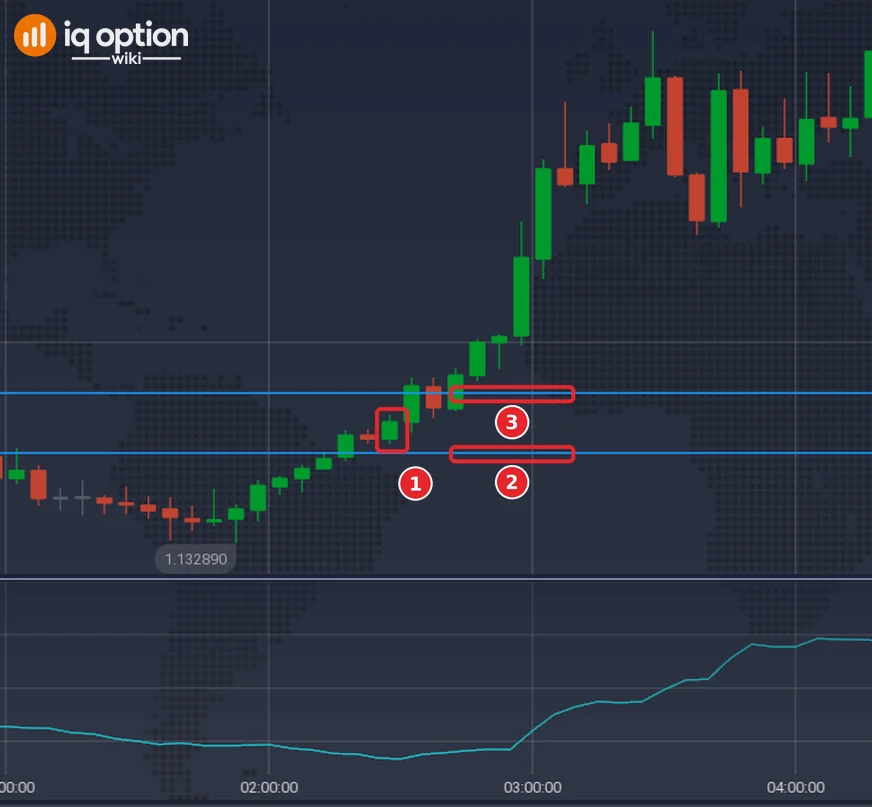
At the 02:25 candle the ATR(14) was 1.66 pips in our replay (the panel read about 1.68), so a stop of one ATR sat at 1.133389 (2) and the 1:1 target at 1.133721 (3), 1.66 pips either side of the entry (1). The next candle reached the target. The distance is not the same from trade to trade: over the whole week one ATR was 3.7 pips on average, and two ATRs 7.4 pips.
Tested on IQ Option: EUR/USD candles of 29 September to 5 October 2026
| Asset and candles | EUR/USD (binary quotes, used here as if for a margin trade), 5-minute candles recorded from IQ Option’s Practice traderoom: 1,334 candles in two stretches without gaps, 1,093 candles from 29 September 01:55 UTC to 2 October 21:00 UTC and 241 candles from 4 October 21:00 UTC to 5 October 17:05 UTC. The traderoom clock used for the times in the guide is UTC minus three hours. Entries are counted from the 32nd candle of each stretch. Nothing was traded. |
|---|---|
| Entries | 159 entries (60 long, 99 short): a long when a candle closes above the highest high of the 20 candles before it, a short when it closes below their lowest low. Every such candle is an entry at its close, so positions overlap, and the three exits are compared on exactly the same entries. A trade is closed after 48 candles (4 hours) at the latest. |
| Exits | A: the stop 0.5 pip beyond the broken level, the target at the same distance from the entry. B: the trade ends at the close of the first candle that closes on the other side of the SMA(30). C: the stop at 1.0 x ATR(14) from the entry, the target at the same distance; C2: the same with 2.0 x ATR(14). When one candle reaches both the stop and the target, the stop counts. |
| A: beyond the level | 72 of 159 trades ended in profit (45.3%): 72 reached the target, 85 the stop, 2 the time limit. Average stop distance 2.72 pips (a pip or less in 39 of the 159 entries); average win +2.66 pips, average loss -2.57; total -31.4 pips (long -31.7, short +0.3). |
| B: SMA(30) | 50 of 159 trades ended in profit (31.4%); 150 ended at the SMA(30), 9 at the time limit. Average win +22.15 pips, average loss -7.28; total +313.9 pips (long -282.8 on 60 trades, short +596.7 on 99). |
| C: 1 x ATR | 83 of 159 trades ended in profit (52.2%): 83 reached the target, 76 the stop. Average distance 3.68 pips; average win +3.49, average loss -3.87; total -4.5 pips (long -12.6, short +8.1). |
| C2: 2 x ATR | 77 of 159 trades ended in profit (48.4%): 76 reached the target, 79 the stop, 4 the time limit. Average distance 7.35 pips; average win +6.81, average loss -7.55; total -95.2 pips. |
The numbers come from replaying candles recorded from IQ Option’s Practice traderoom: no order was placed, and each trade is followed through the logged candles with entries at the close of the breakout candle. There is no spread, swap or slippage in them, and a spread paid on 159 entries would lower every total. They cover one asset over a week in which EUR/USD fell 108 pips in the first stretch and 56 pips in the second, which favours short trades and a trailing exit; the overlapping entries are not independent, and the totals add up the pips of trades that were open at the same time. A rule that did well in this week could lose in the next. No profit is promised. Repeat the test on your own Practice balance before you risk money.
Pros and cons of the three exits
| Exit | Pros | Cons |
|---|---|---|
| Beyond a level | The stop has a reason: it is where the idea fails. Easy to see on the chart. | When the entry candle closes within half a pip of the level the stop is a pip or less from the entry, as in 39 of our 159 entries; 85 of the 159 trades hit the stop, and the average stop was 2.7 pips. |
| Moving average | Needs no target, so a good trend can run: the average win was 22 pips. | Loses more when the trend is against you: the long trades lost 282.8 pips and the short trades made 596.7, in a week when the euro fell. |
| ATR | The stop adapts to volatility, and the distance is the same rule every time. | The multiplier is a choice: one ATR was hit in 76 of 159 trades, two ATRs in 79, and neither turned a profit. |
Common mistakes
- Placing the stop on the edge of the level. IQ Option’s blog: “Placing a stop directly on the obvious high or low can leave no room for normal retesting.”
- Widening the stop after entry. IQ Option’s blog: “Widening a stop increases planned loss and breaks the original size calculation.” Move it only toward break-even, or by a rule set in advance.
- A stop that is tighter than the noise. IQ Option’s blog: “Tight stops get triggered by normal pullbacks.”
- Trusting one week. The moving-average exit made 313.9 pips, all of it on short trades in a week when the euro fell; its long trades lost 282.8 pips. Another week can look different.
- Forgetting the costs. The spread is paid on every trade and a swap on every night: the numbers in the tested box include neither.
Related guides
- Auto closing: take profit and stop loss on IQ Option
- Trading gold on IQ Option
- Support and resistance lines on IQ Option
- Support and resistance breakouts on IQ Option
- Moving averages on IQ Option
- All indicator guides and all strategy guides
Frequently Asked Questions
Q: What is the importance of having an exit strategy?
A: It fixes the loss before the trade starts. IQ Option’s blog says “If you can’t name where you’re wrong, you don’t have a trade.”
Q: Can I use more than one exit strategy?
A: You can combine them in your own plan, for example a stop beyond a level that you move yourself to follow a moving average once the trade is in profit. We counted each exit on its own, so we cannot say how a combination would have done.
Q: How do I set the stop loss with the ATR?
A: Multiply the ATR by a number you choose and put the stop that far from the entry, on the other side from the target. IQ Option’s blog uses 2 to 3 ATR for trailing stops; we tested one and two ATR. In our week neither gave a profit with a 1:1 target.
Q: How often should I move a dynamic stop?
A: The TP and SL fields of the order panel take a fixed value, so a moving-average exit is a rule you check when each candle closes: if the candle closed on the wrong side of the line, you close the trade yourself. If you do move a stop by hand, IQ Option’s blog says “once a trade is live, your stop only moves toward break-even or via a predefined trail rule. Never wider.”
Q: Does a binary option have a stop loss?
A: No. It closes at its expiry, or you can sell it early where the Sell button is offered; see our guide on selling options before expiration.